Monday, October 22, 2012

Blue capped pillars on Mars

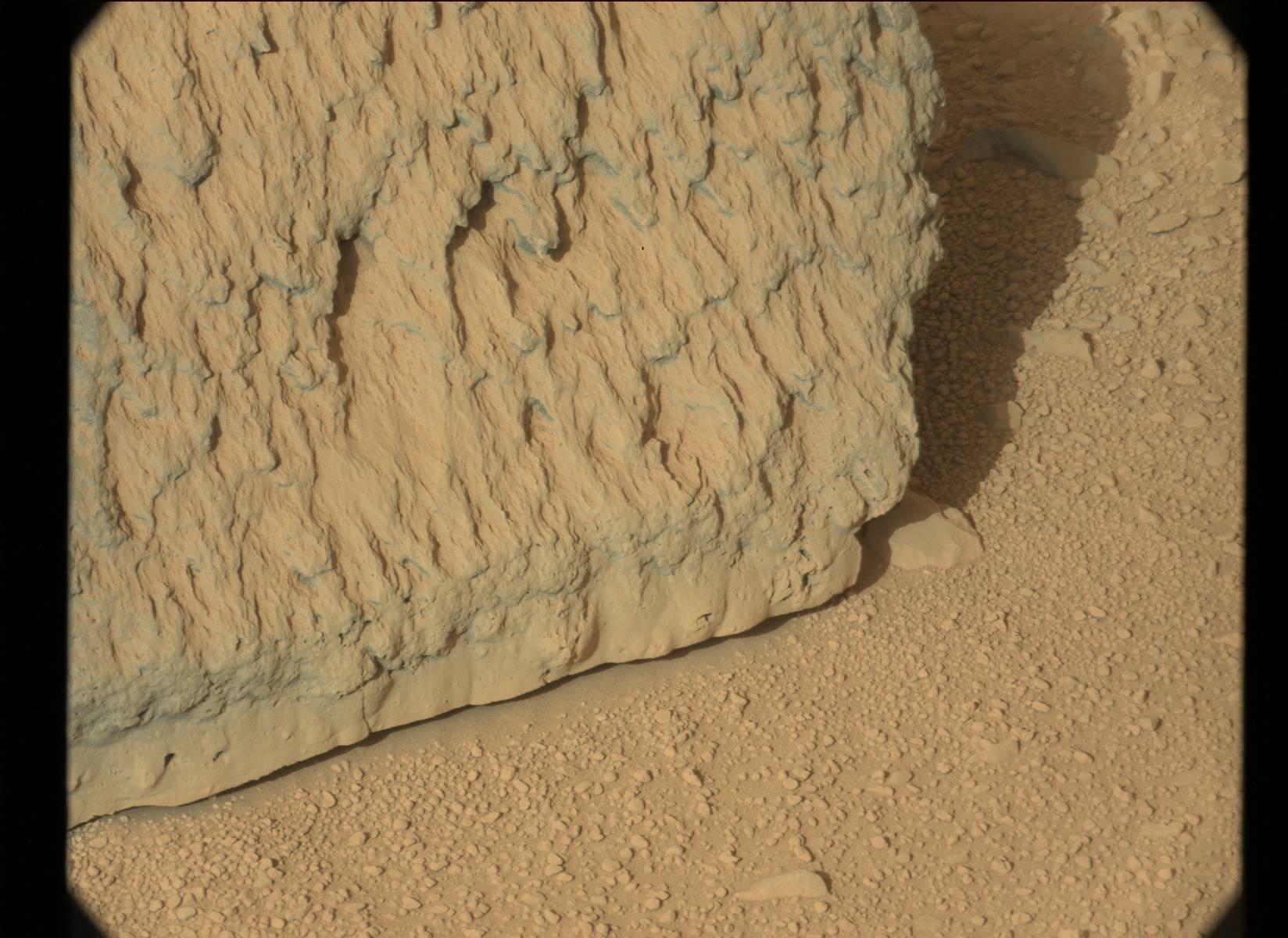
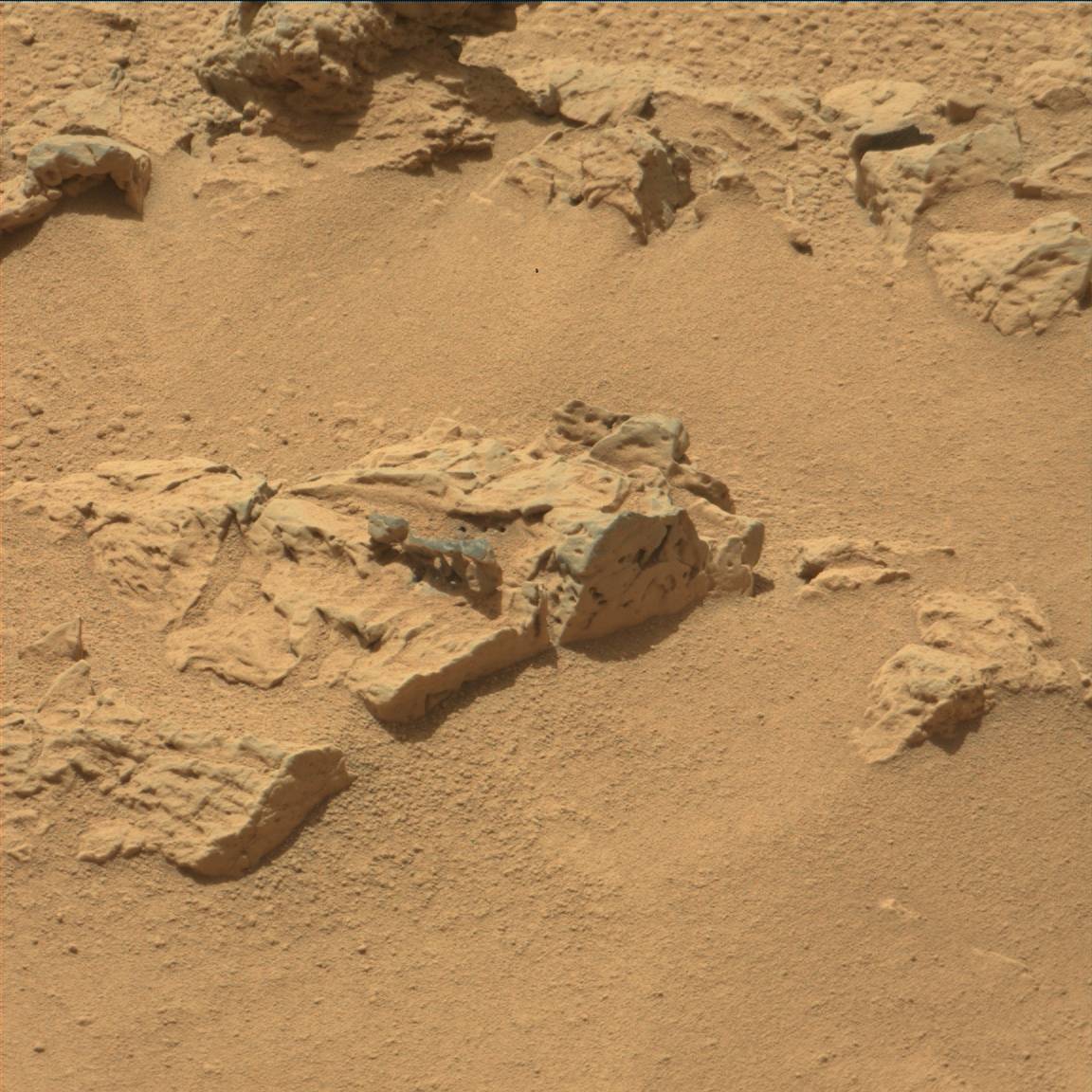
An extraordinary rock formation, photographed with a Curiosity mast camera a few days ago, recieved and released today.

[10/26/12: See update at bottom, from a JPL video that gives a better but incomplete description of what they know about this feature they call "Zephyr" or "Stonehenge".]

It appears to be a row of harder bluish rock blobs with the underlying substrate rock partially eroded away. Is it a ventrifact? Presumably most erosion is due to wind driven abrasion. These pillars are vertical and sandblasting would be expected to undercut harder material, but it's strange that the pillars survived. The bluish caps have a slightly specular surface, and look like they may be translucent with a distinct lower boundary and opaque supporting rock.

The three dark "holes" in the sand behind the pillars are remains after Curiosity laser blasting.

blue capped pillars
There doesn't appear to be any sort of continuation of the form, as you might see in an eroded dyke.

I'm guessing they are agate:
Most agates occur as nodules in volcanic rocks or ancient lavas where they represent cavities originally produced by the disengagement ofvolatiles in the molten mass which were then filled, wholly or partially, by siliceous matter deposited in regular layers upon the walls.
In the formation of an ordinary agate, it is probable that waters containing silica in solution—derived, perhaps, from the decomposition of some of the silicates in the lava itself—percolated through the rock and deposited a siliceous coating on the interior of the vapour-vesicles.  

Original image

8/23/12
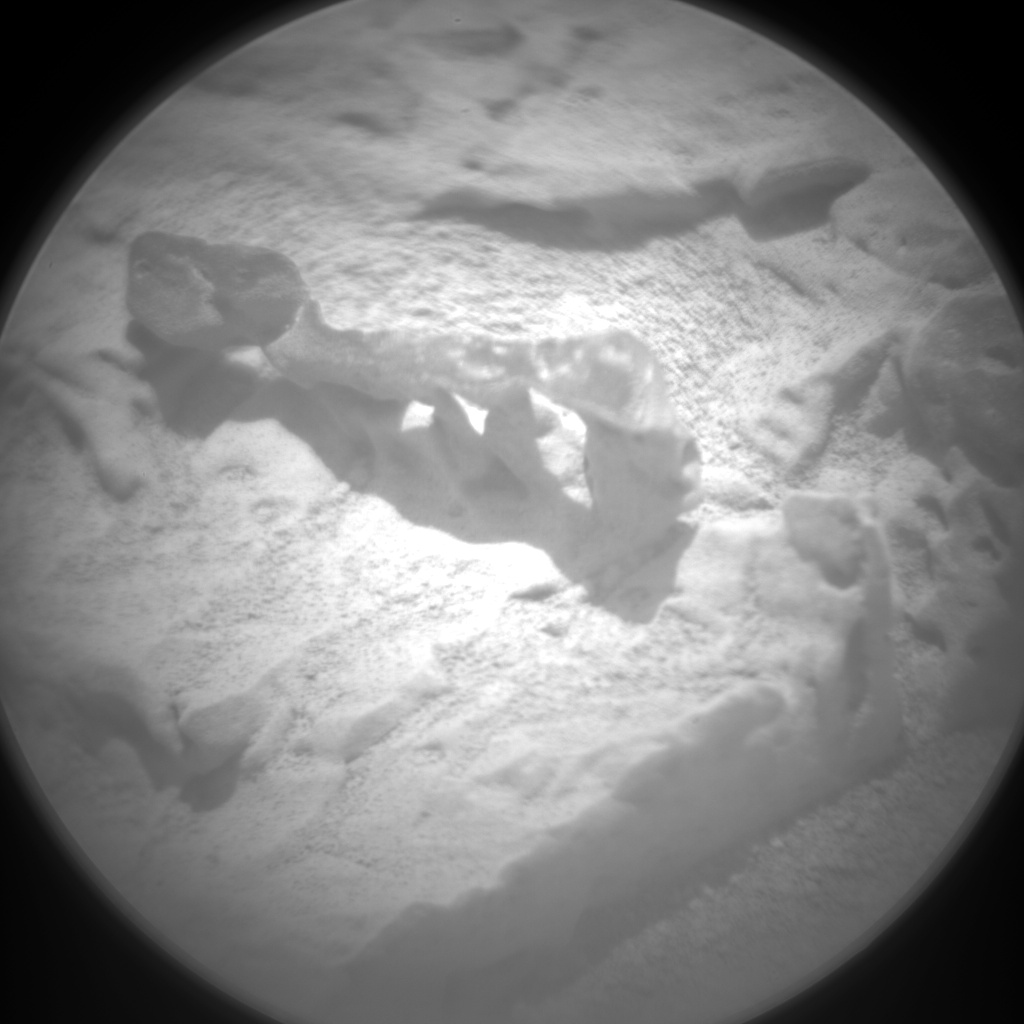
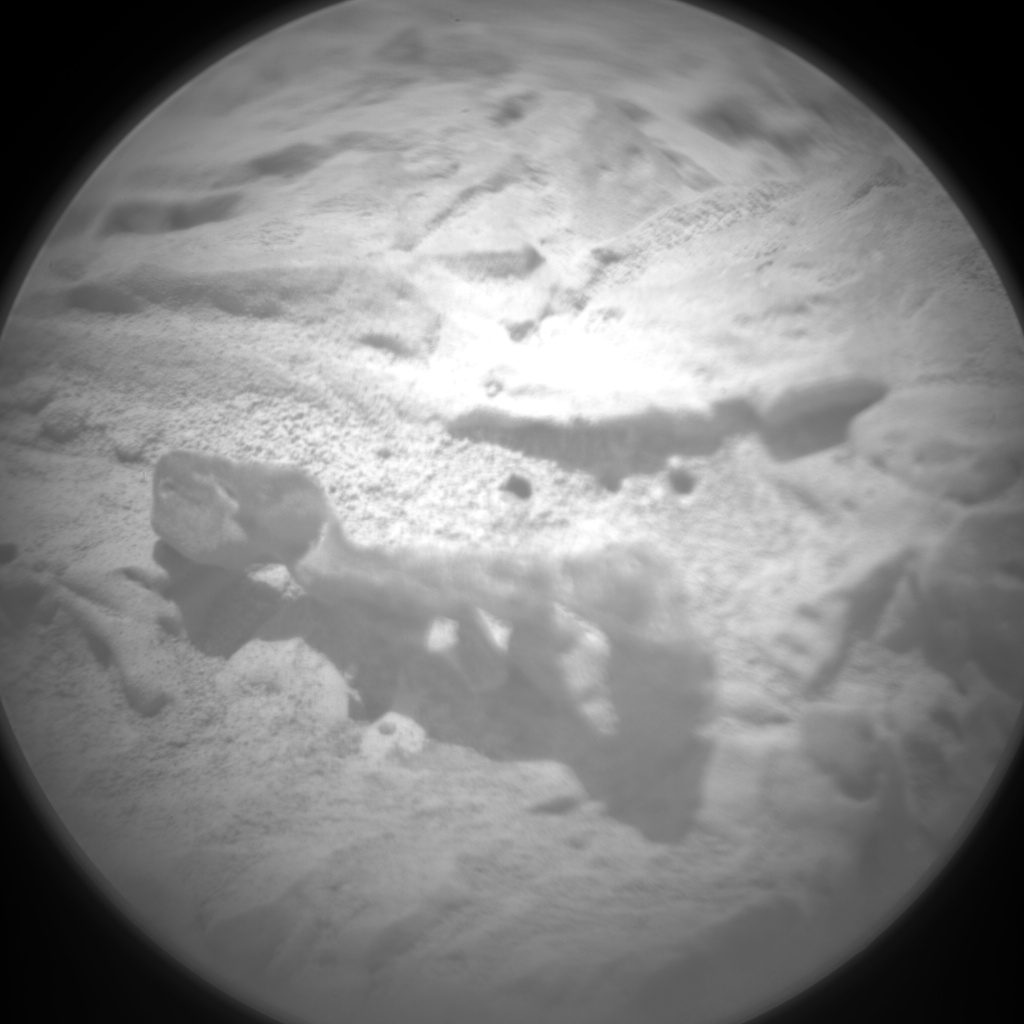
JPL is on it. Here's a ChemCam photo. Notice that the three "holes" (and a fourth, less visible) in the sand behind the formation don't appear in this shot (see below for comparison after shot), but the shadows are in a similar position (a slightly higher sun angle). A close-up photo is needed, if only for the beauty and mystery.

Original image, taken: 2012 OCT 17 20:45:59 EDT

Original image, taken: 2012 OCT 17 21:03:22 EDT, 17 minutes and 22 seconds after the above image. There are also disturbances below the pillars, near the shadow line.

Drat, it missed!! More target practice required, autonomous mode. Don't these robot overlords practice with shoot-em-ups?

I count six misses, including a couple at the base of the pillars, and some pebbles scattered.


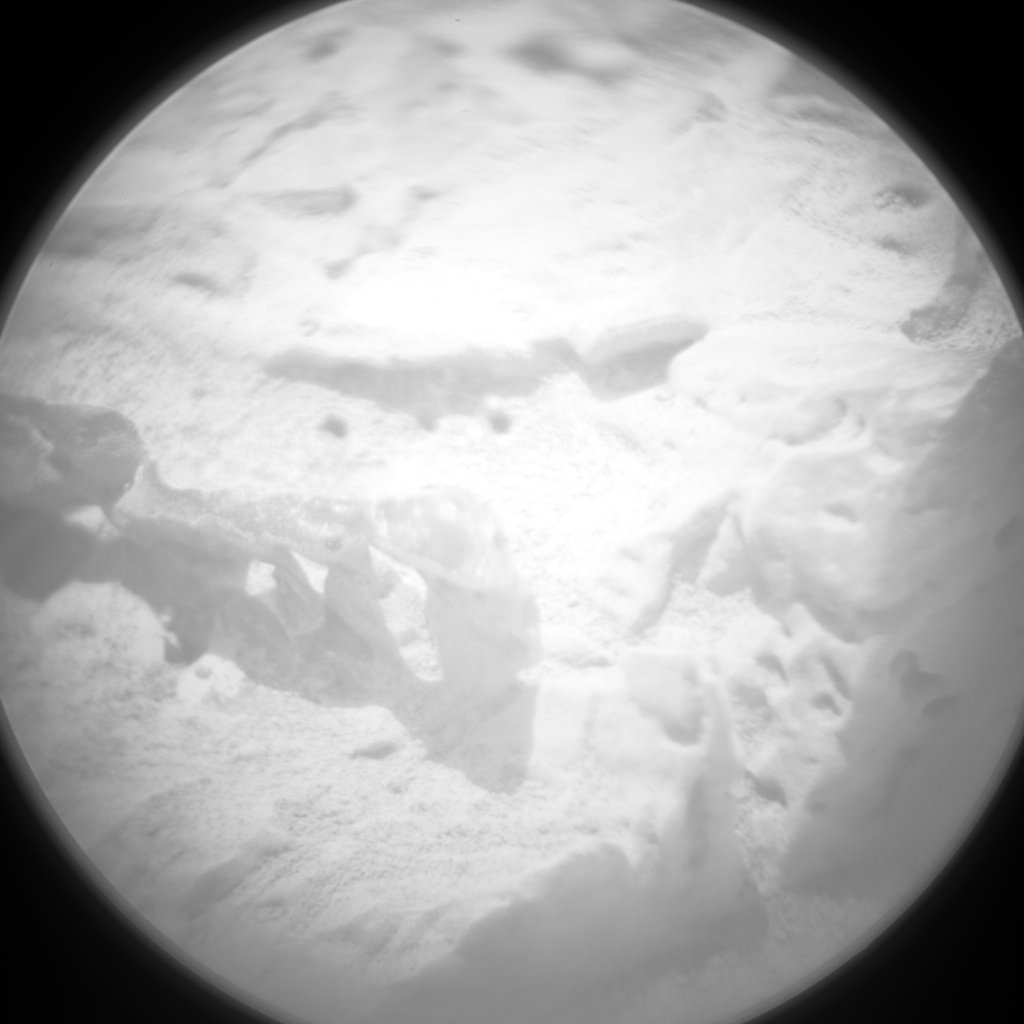
1/23/12 New photo that's more in focus showing that Curiosity had a direct hit, although it is close to the boundary between the blue cap rock and substrate.


Original image, taken: 2012 OCT 23 00:37:01 EDT

Here's the comparison, coregisteed to the single "before" image.


No word yet from JPL on whether they saw a silica signal to be expected from an agate.


From 10/26/12 JPL podcast and YouTube video:

This feature is really only an inch long and we're shooting this from about 8 feet away, making the pointing very difficult.  So that's why we decided to do 9 points instead of just 2, just to make sure we would hit the material of interest. We ended up hitting both the dark and the light material and we found that there was indeed a compositional difference. 
1" scale bar

This feature is really only an inch long and we're shooting this from about 8 feet away, making the pointing very difficult.
JPL marking of laser hits
You can see that this isn't a good representation of where the laser actually hit: two or three of them are just wrong. It's irritating that JPL hasn't released data or results of the spectroscopy.

Saturday, October 20, 2012

Bit of trash on Mars, stereo pair


Stereo pair of a patch of pebbles, dust and a scrap of distressed pastic (about 13mm long), using Curiosity's Mars Hand Lens Imager (MAHLI). The camera was shifted by about 7mm between the views.

NASA speculates that the plastic was part of the delivery vehicle, presumeably shredded during landing and carried by Curiosity to this location about a half-kilometer from the landing site. But if they know what part it is from, they aren't saying.

(stereo pairs, cross-view)


The trash was unexpectedly spotted at bottom center of this photo of the first scoop of soil. It is more visible in the original full size image.

It was a good opportunity to get a high resolution shot of the pebbles covered, and interspersed with, dust.

The two images were taken about 5 minutes apart, with indirect sunlight.

Thursday, October 4, 2012

Closeups on Mars


Photography by Curiosity in Gale Crater:

One corner of a pyramidal rock named Jake Matijevic.
Original: 0044MR0204022000E1_DXXX
Nice wider view
Composition and other information


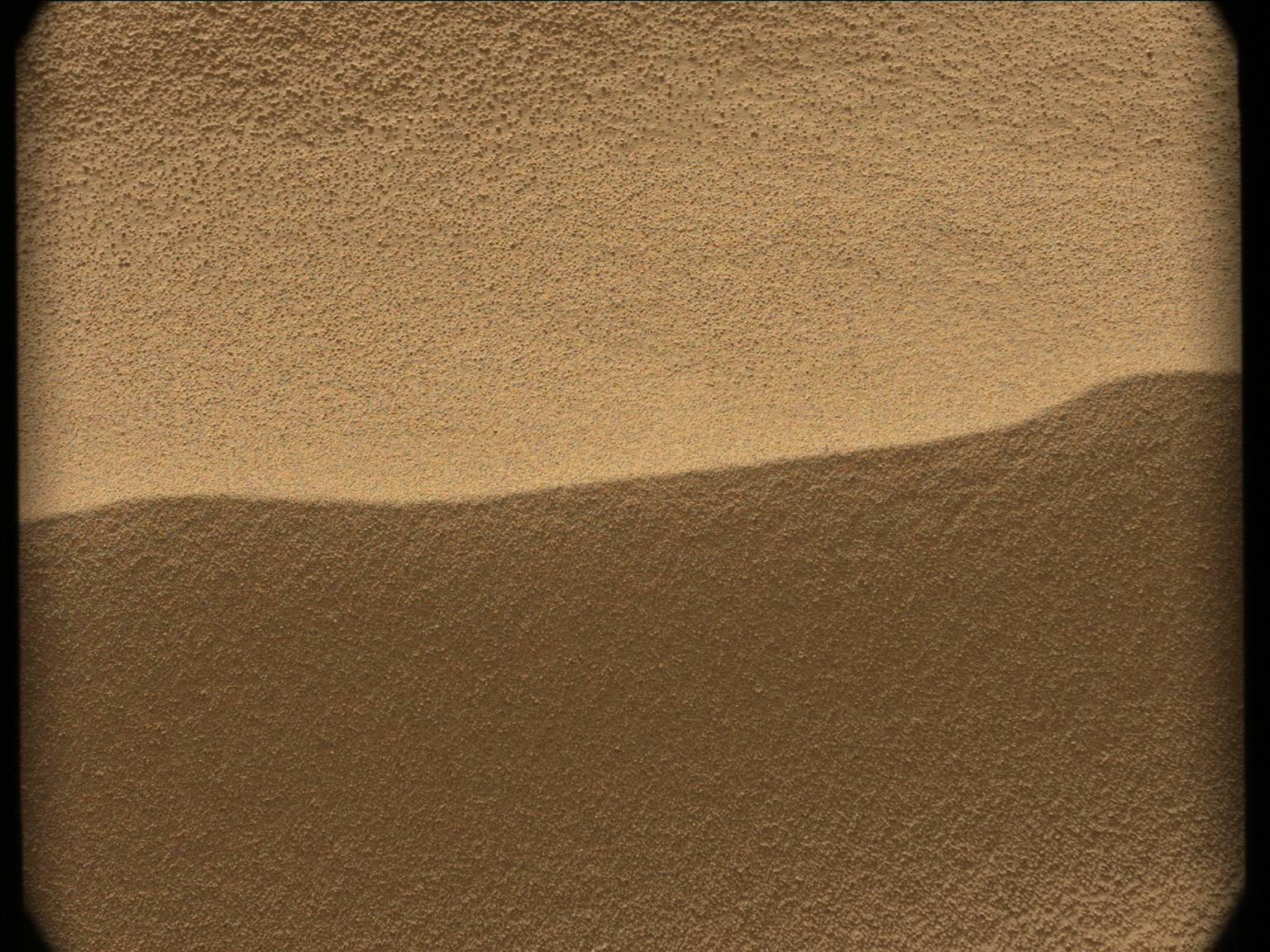
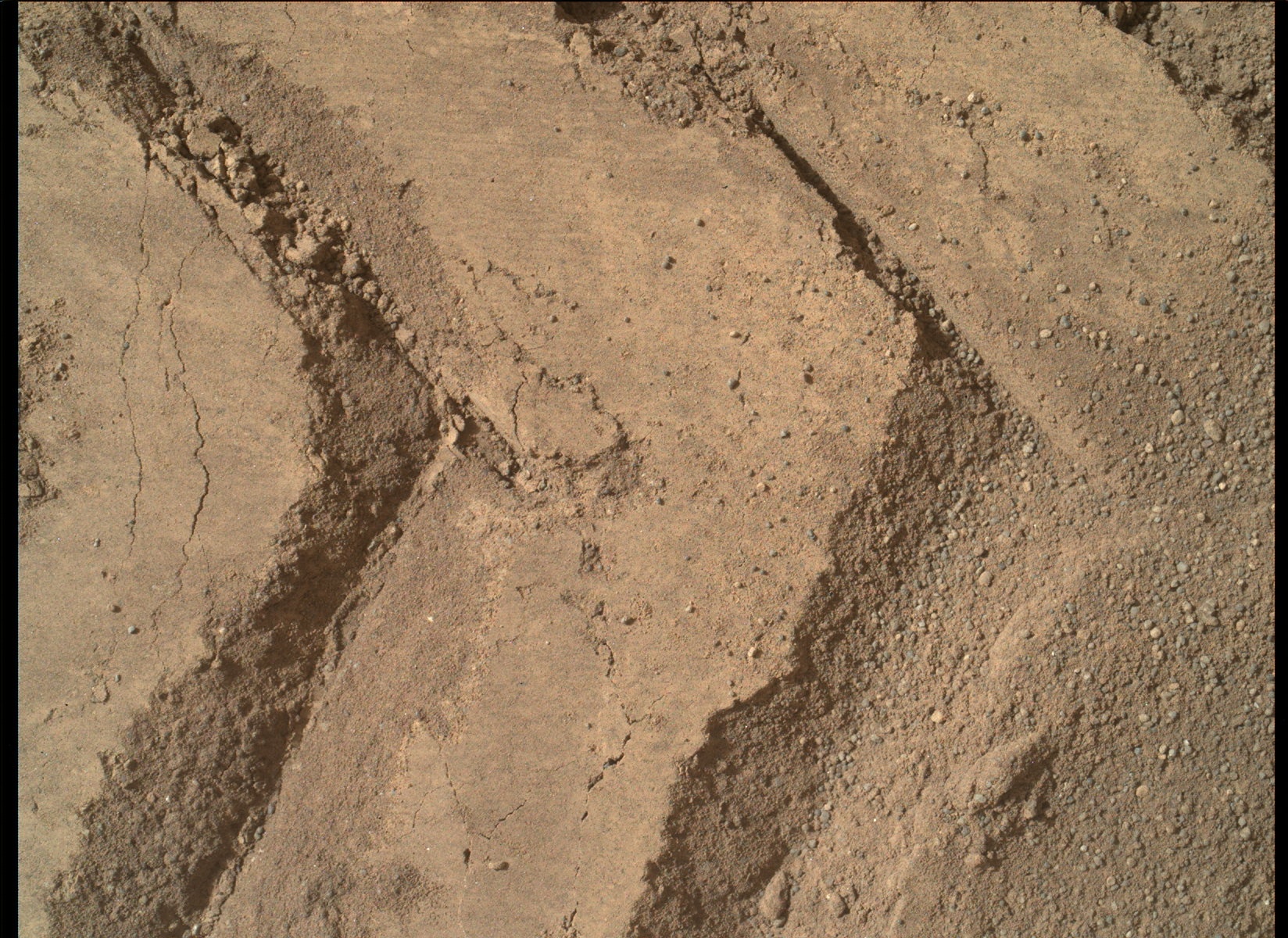
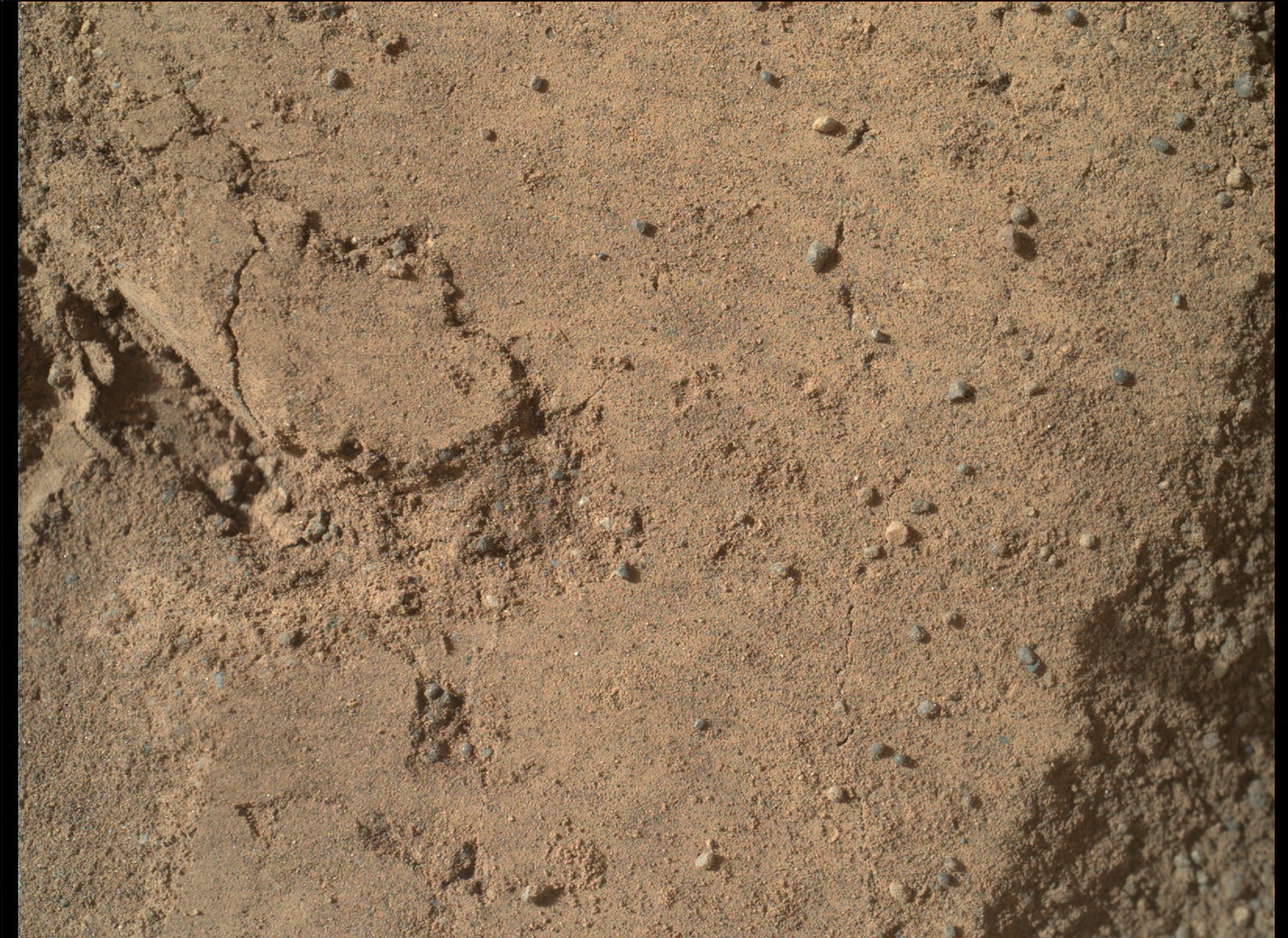
Sand ripple on patch of ground named Rocknest. I don't know the exact scale, but it looks to be about 30-60 cm wide. The small blobs of texture seem to be pebbles coated in dust.

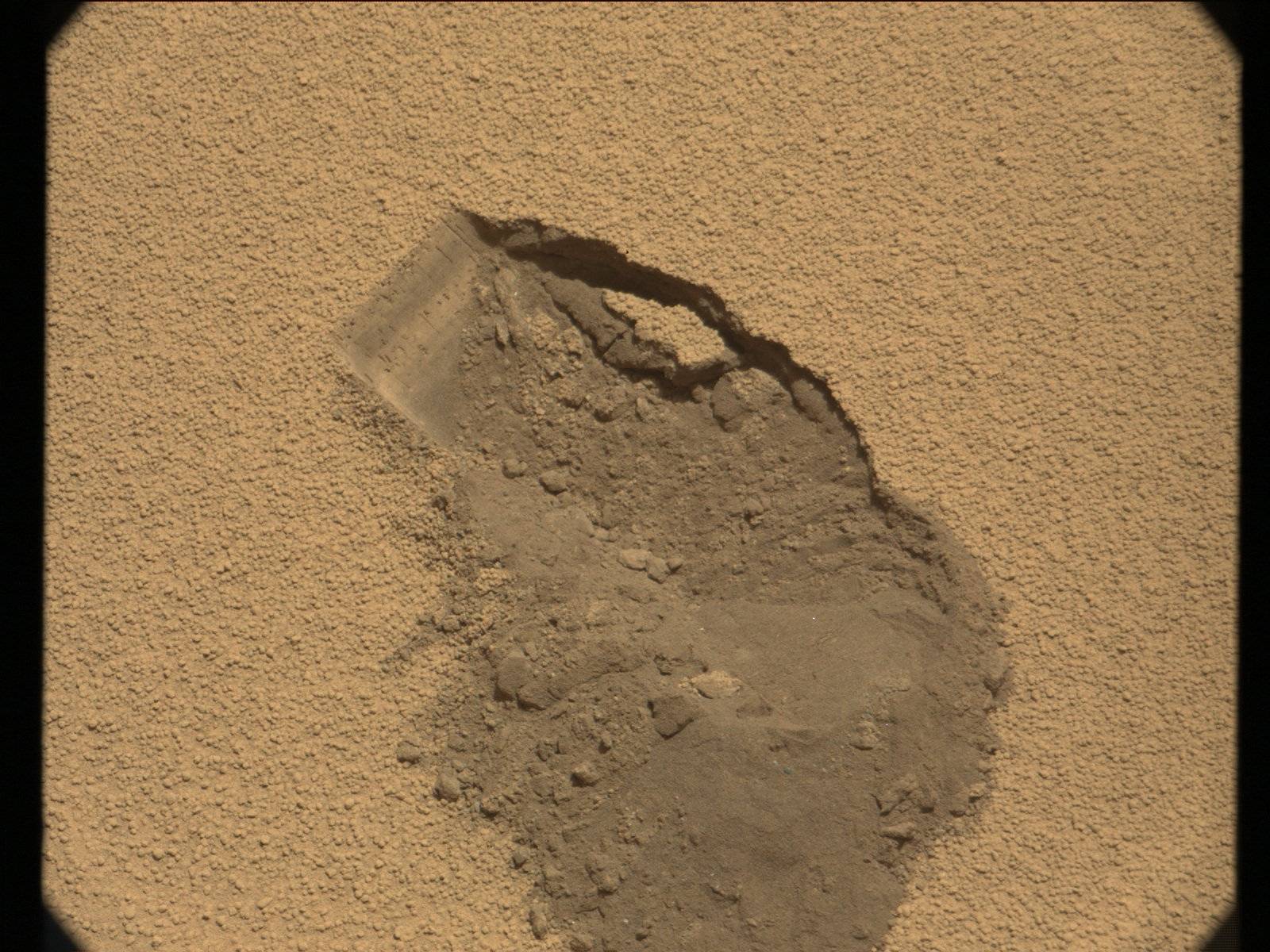
After a scoop from near the ripple.

The ripple above extends into the foreground of this navigation camera photo, looking to the rim of Gale Crater.

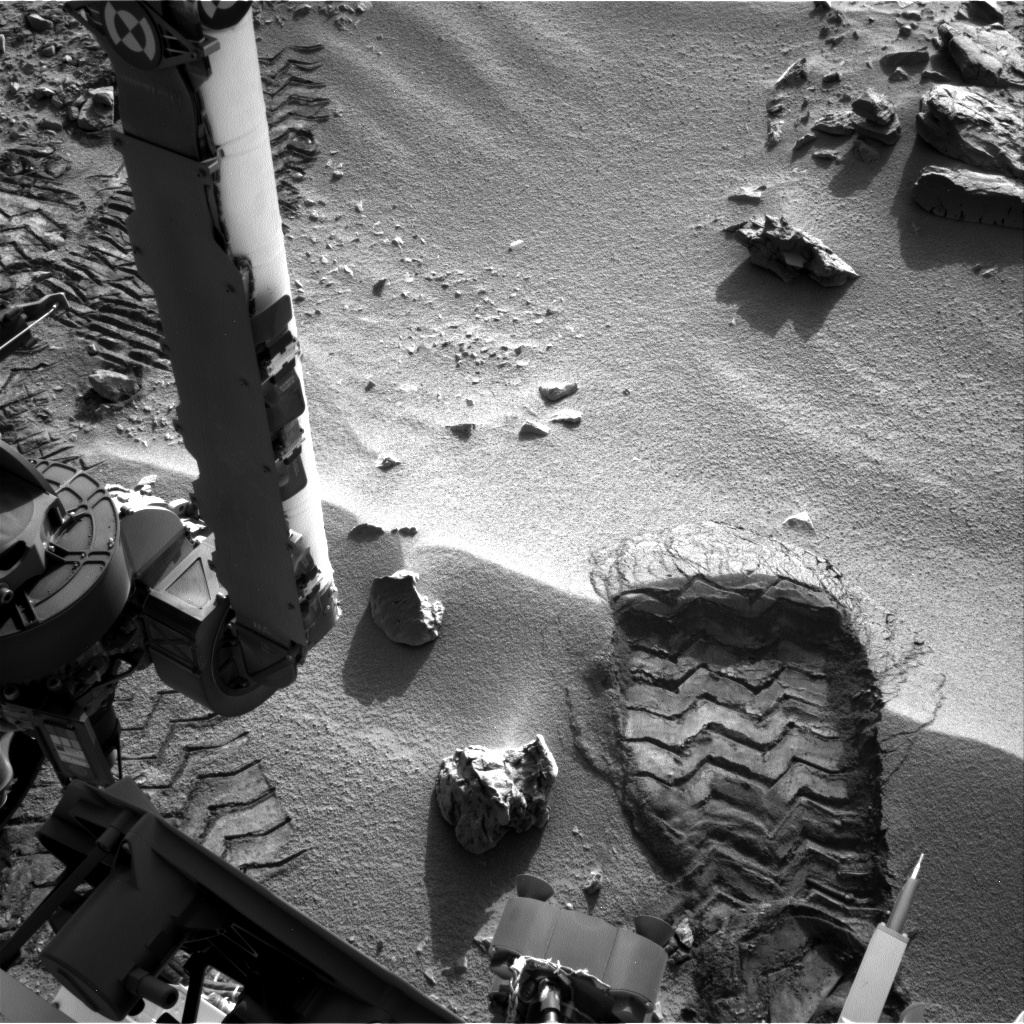
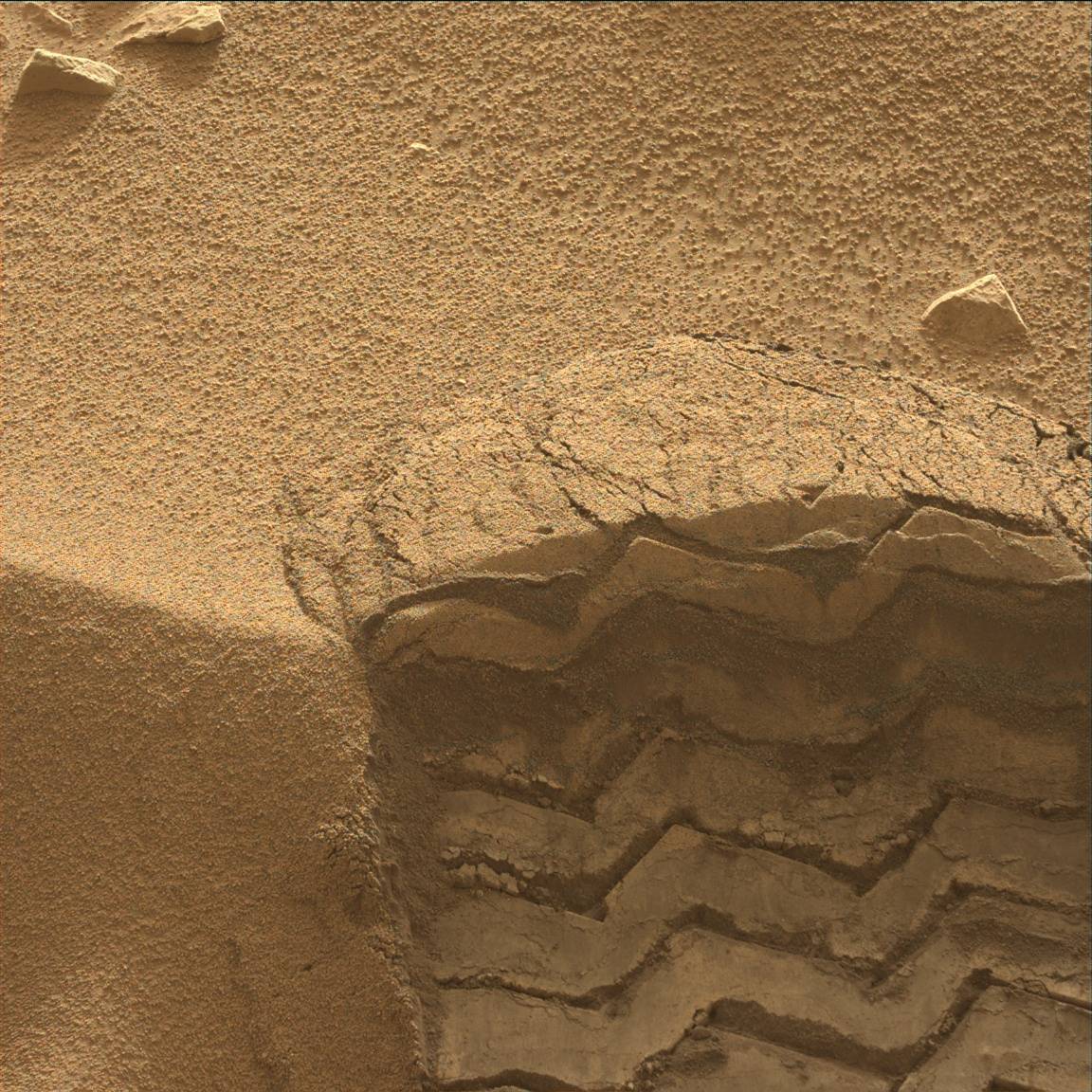
Robot wheel impression across the ridge. The body of the ripple appears to be very fine grained, more like flour than sand.


Top of wheel print above, but with different sun angle (time of sol). Original.

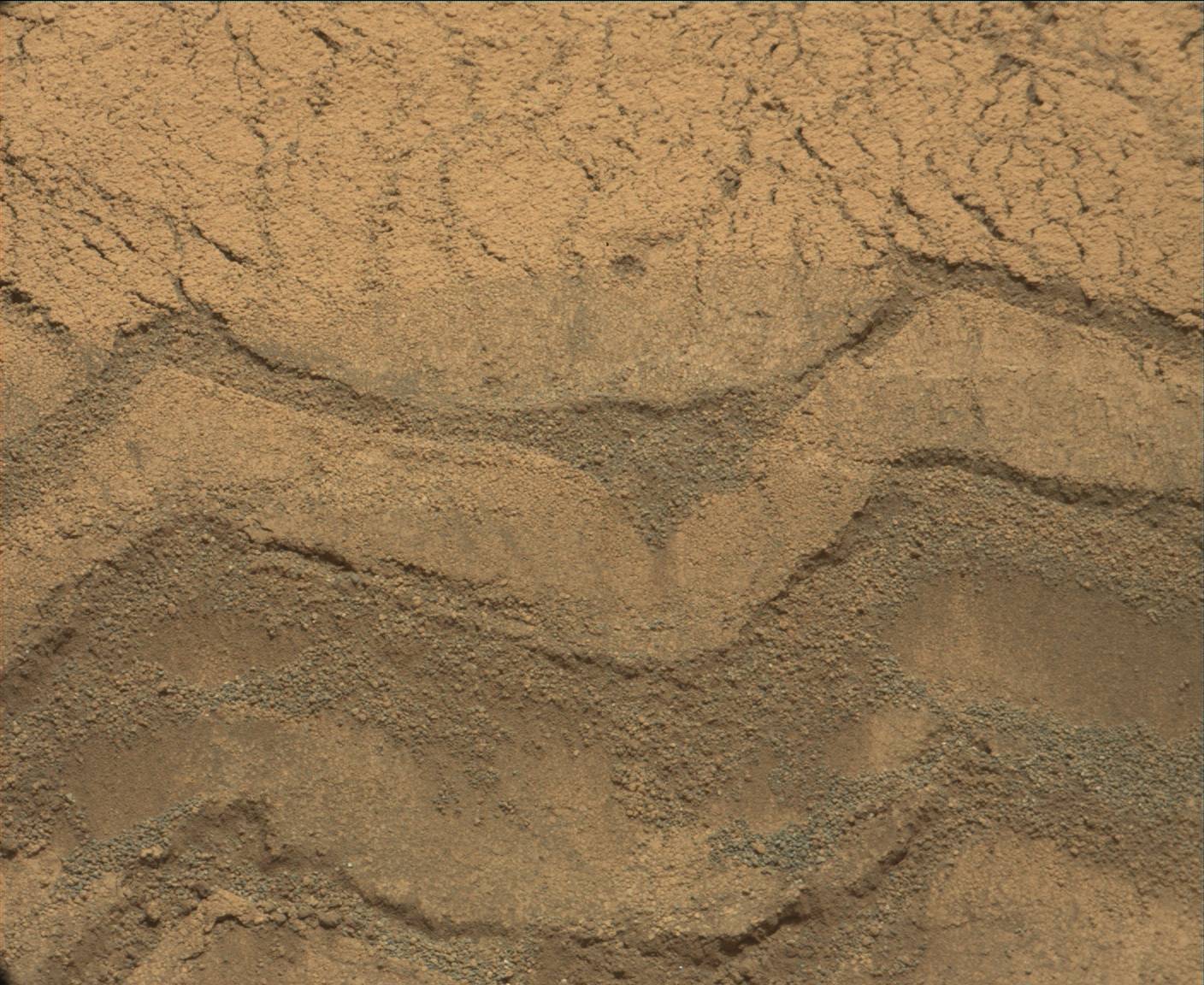
Closeup of part of this wheel-print. Original. The straight horizontal bands are impressions of the wheel surface (see wheel image below).

And closer. Original.


Closer view at edge of imprint:
"The largest grains ... are about 0.04 to 0.08 inches (1 to 2 millimeters) in size. The bulk of the sand in the ripple is smaller, in the range below 0.002 to 0.008 inches (50 to 200 microns).


Wheels of Curiosity that made the impressions. Each is about 40 cm wide. Notice the fine linear texture of the left wheel in the highlight. This pattern is seen as horizontal bands in the dust (two images above, top).
Original.


Tuesday, August 28, 2012

Laser blasting request

JPL: Please instruct your robot to laser blast and spectro-analyze the rock face causing saturated luminance.


Is this due to an unusually high albedo? It might be just a flat face with high specular relflectance, but there is no other like it in any other field of view, so it seems statistically unlikely. Perhaps it is a boundary between radically different sediment layers, deposited as ejecta from some meterorite hit. An evaporite?

The shadowed side is consistent with the lightness extending through the body of the rock. And there appears to be a darker band between the top and bottom portions.

These exposures at different times of day (note the shadows) show that there is not a lot of specular reflection.


from http://mars.jpl.nasa.gov/msl-raw-images/msss/00020/mcam/0020MR0056005000C0_DXXX.jpg
from http://mars.jpl.nasa.gov/msl-raw-images/msss/00019/mcam/0019MR0059002000C0_DXXX.jpg


Just curious. Thanks in advance.


Thursday, August 23, 2012

Skycrane jet wash

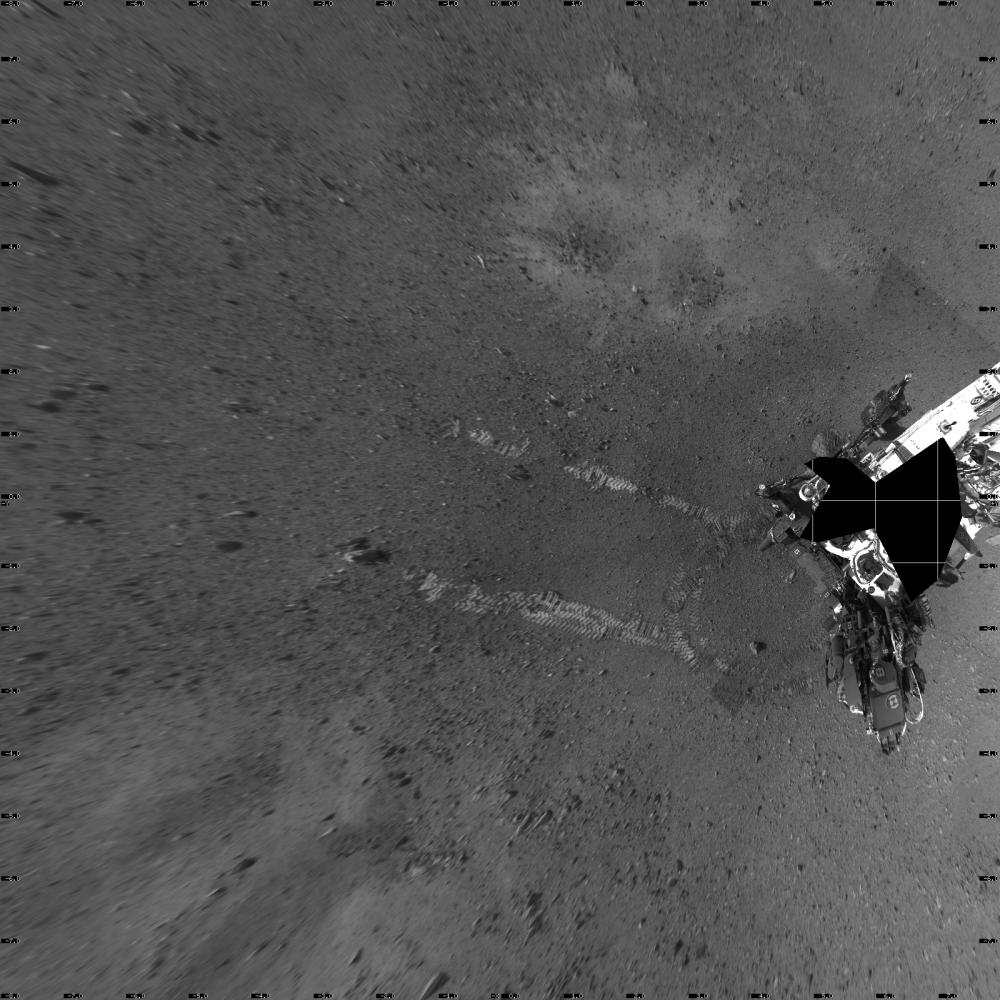
When landing on Mars, the MSL skycrane held a fixed position while lowering Curiosity. There happened to be a lot of unconsolidated dust and pebbles, some of which got blown onto Curiosity.

The navigation cameras (Navcam) take beautiful 1000 x 1000 pixel stereo pairs. These views, with the shallow pits caused by the jet wash, are from sol 16 after Curiosity moved a short distance from its landing position.

Navcam A, stereo pair (cross-view)

Navcam A, stereo pair (cross-view)
Here's the plan view of these features, and Curiosity, from this vantage point:


"And then... Try to imagine all this sequence of landing and preparations as you were standing there and watching. Friggin metal spider with rocket engines lowers this car sized rover, flies away and crashes. This rover then sits there for couple sols without any movement. But from time to time it makes some tiny sounds, moves it's robotic arm, turns camera. And sits there again for hours. Zaps a tiny rock with laser. On one sol it starts moving. Moves couple meters here and there, turns around, goes silent again. It's like from some sci-fi book, except we actually are (let's get back to Earth) here and experience it. Not directly, but.. Hey, how cool is that every day we commute to work, hang out with friends and have new pictures coming to our pockets from another friggin planet hundreds of millions kilometres away. I think I need a drink now." Tadas Jelinek, comment on Boing Boing post.


Original pictures:

Navcam: Left and Right A (NAV_LEFT_A, NAV_RIGHT_A) onboard NASA's Mars rover Curiosity on Sol 16 (2012-08-22 15:02:31 UTC):

http://mars.jpl.nasa.gov/msl/multimedia/raw/?rawid=NLA_398919607EDR_F0030078NCAM00300M_&s=16
http://mars.jpl.nasa.gov/msl/multimedia/raw/?rawid=NRA_398919607EDR_F0030078NCAM00300M_&s=16

Navcam: Left and Right A (NAV_LEFT_A, NAV_RIGHT_A) onboard NASA's Mars rover Curiosity on Sol 16 (2012-08-22 15:00:53 UTC):

http://mars.jpl.nasa.gov/msl/multimedia/raw/?rawid=NRA_398919509EDR_F0030078NCAM00300M_&s=16
http://mars.jpl.nasa.gov/msl/multimedia/raw/?rawid=NLA_398919509EDR_F0030078NCAM00300M_&s=16


A gallery of several of the first stereo pairs taken by the navigation cameras: http://imgur.com/a/Mc9OA#0


Wednesday, March 14, 2012

Half Tau Day

Half tau is not imaginary, but logarithms of negative numbers can be.

Secnarf got me interested in the function x^x, which is real valued for positive values of x, but wonderfully complex for negative x.
Functions that are powers of a variable are often more simple after taking a logarithm of the function, so I was curious what ln(x^x) might look like:
Sure enough, the imaginary part of this function is piecewise linear. What are the slopes of these segments? For that we just need the derivative with respect to x, d( ln( x^x) )/dy (function in blue, derivative in magenta):
The imaginary part of the derivative (bottom, magenta), shows that the slope is constant, a bit more than 3. In fact, the slope is exactly half tau.

Something similar happens (for the same reason) when we take the logarithm of both sides of Euler's identity:

ln( e^i*Ï„/2 ) = ln( -1 )

which can be used as defining the logarithm of a negative number. This reduces to:

i * Ï„/2 = ln( -1 )

So half tau is the magnitude of the imaginary part of the natural logarithm of -1:

Ï„/2 = ln( -1 )/i


Wednesday, February 15, 2012

MIT 6.002x (Circuits and Electronics)

I'm going to take this new Massachusetts Institute of Technology (MIT) course offering:

6.002x (Circuits and Electronics) is an experimental on-line adaptation of MIT’s first undergraduate analog design course: 6.002. This course will run, free of charge, for students worldwide from March 5, 2012 through June 8, 2012.

I found this course through the BBC article, "MIT launches free online 'fully automated' course", 13 February 2012.
[The course] has been designed for online students, with a virtual laboratory, e-textbooks, online discussions and videos that are the equivalent of a lecture. It is expected to take 10 hours per week and will run until June.
Anant Agarwal, one of the course teachers, says it has been "designed to try to keep it engaging".
I'm particularly interested in how well they can pull off an online course like this, how engaging and/or frustrating it might be. I know a lot of the material that will be covered, but it's not my specialty.

I'm tinkering with an Arduino microcontroller and it will be a good way to increase my design capabilities. It would be nice to replicate and extend some of the labs on the Arduino, to get the full experience of handling real devices and physical problems, instead of idealized simulacrums. Someone should make parallel lab instructions for Arduino. Maybe I'll try putting one together myself.


Course description:

Designed to serve as a first course in an undergraduate electrical engineering (EE), or electrical engineering and computer science (EECS).

Introduces the lumped element model, a standard analytic tool for describing the dynamics of circuits (and similar systems).
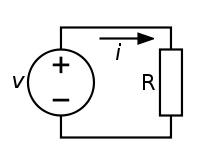
(Example representation of a lumped model made up of a voltage source V and a resistor R, with electric current i. This model of an electronic circuit makes the simplifying assumption that the attributes of the circuit, resistance, capacitance, inductance, and gain, are concentrated into idealized electrical components; resistors, capacitors, and inductors, etc. joined by a network of perfectly conducting wires.)
Topics covered include: resistive elements and networks; independent and dependent sources; switches and MOS transistors (MOSFET); digital abstraction; amplifiers; energy storage elements; dynamics of first- and second-order networks; design in the time and frequency domains; and analog and digital circuits and applications. Includes design and lab exercises. Approximately 10 hours per week required.

Textbook:

Foundations of Analog and Digital Electronic Circuits, Agarwal and Lang, 2005. The book is not required: relevant sections will be provided electronically as part of the online course.
A unified treatment of circuits and electronics, establishing a strong connection with digital systems. Introduces a new way of looking at the treatment of circuits and introductory coursework in engineering in general. 
The book attempts to form a bridge between physics and large computer systems. Treats electrical engineering and computer science as the creation and exploitation of abstract models to manage the complexity of building electrical systems.
Prerequisites:

AP level physics course in electricity and magnetism. Basic calculus, linear algebra, some background in differential equations. The first half of the course will include an optional remedial differential equations component.


Course staff include:
Anant Agarwal
Director of Computer Science and Artificial Intelligence Laboratory (CSAIL). Parallel computer architectures and cloud software systems, founder of several startups, including Tilera that produces scalable multicore processors. Co-authored the course textbook.

Gerald Jay Sussman
Educator in computer science, author of Structure and Interpretation of Computer Programs, the creator of Scheme. Artificial intelligence, physics, chaotic systems, supercomputer design.
Piotr Mitros
Techniques from control systems to optimize the learning process, analog designer at Texas Instruments, Talking Lights. Designed the analog front end for a novel medical imaging modality for Rhythmia Medical.

Saturday, July 16, 2011

Programmers Anonymous notes, 1100

Griffin wondered about how laser diodes work.
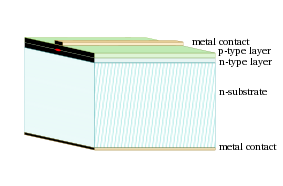
A laser diode is formed by doping a very thin layer on the surface of a crystal wafer. The crystal is doped to produce an n-type region and a p-type region, one above the other, resulting in a p-n junction, or diode.
...
When an electron and a hole are present in the same region, they may recombine or "annihilate" with the result being spontaneous emission — i.e., the electron may re-occupy the energy state of the hole, emitting a photon with energy equal to the difference between the electron and hole states involved. Spontaneous emission gives the laser diode below lasing threshold similar properties to an LED.
 The structure, a lasing medium between two conductive partial mirrors, is simple:
The physical chemistry is more complicated, and it took a lot of research to find out how to get it right so they work at room temperature, are cheap, and last a while.
This is a visible light micrograph of a laser diode taken from a CD-ROM drive. Visible are the P and N layers distinguished by different colours. Also visible are scattered glass fragments from a broken collimating lens.
The first laser diode to achieve continuous wave operation was a double heterostructure demonstrated in 1970 essentially simultaneously by Zhores Alferov and collaborators (including Dmitri Z. Garbuzov) of the Soviet Union, and Morton Panish and Izuo Hayashi working in the United States. However, it is widely accepted that Zhores I. Alferov and team reached the milestone first. For their accomplishment and that of their co-workers, Alferov and Kroemer shared the 2000 Nobel Prize in Physics.


David Byrne, Lead Singer of Talking Heads in 1987:
I don't think computers will have any important effect on the arts in 2007. When it comes to the arts they're just big or small adding machines. And if they can't "think," that's all they'll ever be. They may help creative people with their bookkeeping, but they won't help in the creative process.


Simultaneous localization and mapping (SLAM) on an iPad2:


The Singularity is Far: A Neuroscientist's View, including many interesting thoughts in the comments.


Art && Code: 3D

Kinect-Hacking Conference

Art && Code: 3D is a festival-conference about the artistic, technical, tactical and cultural potentials of 3D scanning and sensing devices — especially (but not exclusively) including the revolutionary Microsoft Kinect sensor. This highly interdisciplinary event will bring together, for the first time, tinkerers and hackers, computational artists and designers, industrial game developers, and leading researchers from the fields of computer vision, HCI and robotics. Half-maker’s festival, half-academic symposium, Art && Code: 3D will take place October 21-23 at Carnegie Mellon University in Pittsburgh, and will feature:
  • Hands-on workshops in programming interactive software with the Kinect, using popular arts-engineering toolkits such as Processing, openFrameworks, Cinder, Max/MSP/Jitter, Pure Data, and Microsoft’s own Kinect for Windows SDK in Silverlight.
  • Presentations by leading artists, designers, and researchers about their projects with depth cameras.
  • An interactive exhibition and live performance evening featuring artworks, robotics, games and other experiences using the Kinect.

Omek Raises $7 Million From Intel, Aims To Challenge Microsoft’s Kinect

Omek Interactive, a provider of tools that enables companies to incorporate gesture recognition and full body tracking into their applications and devices, has secured $7 million in financing in a round led by Intel Capital, TechCrunch has learned. The Series C round brings the company’s total funding raised to nearly $14 million.
Omek’s Beckon technology converts the raw depth map data from most major 3D cameras into an awareness of people and their movements or positions in front of the camera, enabling them to be converted into commands that control hardware or software.


Solving laundry at UC Berkeley (Willow Garage)


Nearly a million people have watched UC Berkeley's PR2 folding towels and sorting socks on YouTube, and it's easy to understand why: having a robot that can do your laundry is a fantasy that's been around since The Jetsons, and while we're not there yet, it's not nearly as far off a future as it was before the PR2 Beta Program. Since those demos, one of the research groups at Berkeley has been working on ways of making the laundry cycle faster, more efficient, and more complete, and for starters, they've taught their PR2 to reliably handle your pants.
The goal of Pieter Abbeel’s group is to teach a robot to solve the laundry problem. That is, to develop a system to enable a robot to go into a home it's never seen before, load and unload a washer and dryer, and then fold the clean clothes and put them away just like you would. The first aspect of this problem that the group tackled was folding, which is one of those things that seems trivial to us but is very difficult for a robot to figure out since clothes are floppy, unpredictable, and often decorated with tasteless and complicated colors and patterns.

[ Update on robotic laundry folding fantasy, 2026-02-16:
It's still a fantasy. 

$8K laundry bot knows when to hold ’em, knows when to fold ’em, and knows it has help standing by

Not-onamous by a long shot

https://www.theregister.com/2026/02/12/laundry_folding_robot_8000_dollars_teleoperated/
 ]

In Search of a Robot More Like Us

Although robots have made great strides in manufacturing, where tasks are repetitive, they are still no match for humans, who can grasp things and move about effortlessly in the physical world. Designing a robot to mimic the basic capabilities of motion and perception would be revolutionary, researchers say, with applications stretching from care for the elderly to returning overseas manufacturing operations to the United States (albeit with fewer workers).
Yet the challenges remain immense, far higher than artificial intelligence hurdles like speaking and hearing.


7x21 pixel display, and is 2.5 x 7 feet in size, using an Arduino Decimillia board.

Monday, July 11, 2011

Programmers Anonymous notes, 1011

Distinguishing between sarcasm and irony is ironic. Expressing an opinion about the distinction is sarcastic.


Claire L  Evans, from Portland Or, writes about (and does art/performance about) science and technology issues. Her sequence of blogs about moon arts strike a chord.


What gestures should a vision system understand? A prime requirement is that gestures should be easily learned by humans, but it is not clear what is most natural or effective. Here's a discussion of future gesture interfaces for the Kinect. It's anybody's guess as to what will work well enough for people. The best way to find out is to try things:


While dropping off Cosmo for a summer camp I had the chance to check out their exhibit of video games, Game On 2.0, at OMSI: I wasn't expecting much, but was very impressed. Not only are the games set up well to be played, there was an impressive range of platforms and hardware, from handheld to pinball. Mixed in was good information about the game industry, game development and some original art. The tacit message was that computer games are not just a bit of pointless fun, but a driver of  the computer industry.
Play your way through the past, present, and future of global gaming. From Pong to Gran Turismo, Game On 2.0 is a hands-on experience of video game history and culture, and includes over 125 playable games, including Mario All Stars, Wii Sports, Gran Turismo, Halo Reach, Pacman, Zelda and Sonic the Hedgehog.

Explore over 40 years of gaming entertainment; from the very first commercial coin-op game to the latest in virtual reality and 3D technology. Game On 2.0 celebrates game design, development, and production including original concept and character art and history’s most influential arcade consoles.

RoboCup 2011 is finishing up today, furthering the goal of:
By mid-21st century, a team of fully autonomous humanoid robot soccer players shall win the soccer game, complying with the official rule of the FIFA, against the winner of the most recent World Cup.
While I think AI will advance enough to achieve this goal, I predict that the battery/power technology will be woefully inadequate to the task for many years, if not decades.  Electric cars have been around for more than 100 years now, and everyone agrees they are a good idea, but you still can't plug in a Prius.

And the best soccer team won't be humanoid, no matter how photogenic; we are just not that cute or functional on the pitch:

I think that the soccer playing premise is good, but I'm more interested in video game playing robots. Games are designed to tweak our interest and exercise our humanity, while soccer is largely a sport for spectators. When will a robot master Pong, PacMan, or World of Warcraft?

I don't know the answer, but this is what will close the gap in embodied intelligence. Below is a first step toward that goal, a three electro-mechanical relay bot that "plays" the Tower of Hanoi faster than a human, on a device designed to use human gestures (taps). While the sequence of moves is not found autonomously, it won't be long before robots will entertain themselves by game play.


In base 24 the first eight powers of five are palindromic (Wikipedia, palindromic numbers in other bases). Why? Is it likely that there is a logical reason for this string of palindromes?:
51 =          5
52 =         11
53 =         55
54 =        121
55 =        5A5
56 =       1331
57 =       5FF5
58 =      14641
5A =     15AA51
5C =    16FLF61


What do robots look like? Often it assumed they will evolve toward some sort of human form, and many are wedged into this bipedal mold. What about real robots, those designed for practical use where there is less anthropomorphic social pressure?

Industrial robots have decades of experience now, and their range of forms has settled down. They have one arm and no legs, and are typically bolted to the floors or on a specialized gantry. Here's one marketed to foundries, the KUKA KR 1000 Titan:

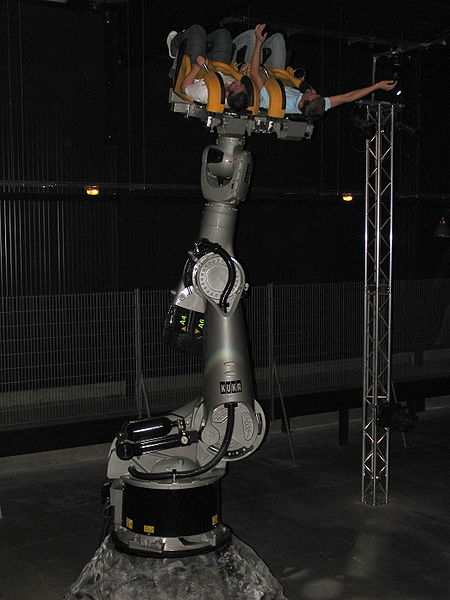
While this is a larger model, its body plan is recognizable in a wide range of industrial bots. Most industrial robots are quite a bit larger than humans, even though they are typically used for human scale products like cars. They don't know their own strength, and don't pay much attention to humans, so photos of them with humans are not common. Here's a similar KUKA bot swinging around a couple humans like so much meat (Wikipedia, Robocoaster):

What about autonomous robots? They have much different design requirements and are still evolving. Often they have a more car-like body plan. After several iterations we now know what the near-future looks like, the most sophisticated semi-autonomous bot ever:
NASA Mars Science Laboratory rover, Curiosity, \during mobility testing on June 3, 2011. The location is inside the Spacecraft Assembly Facility at NASA's Jet Propulsion Laboratory, Pasadena, Calif.
Preparations are on track for shipping the rover to NASA's Kennedy Space Center in Florida in June and for launch during the period Nov. 25 to Dec. 18, 2011.
JPL, a division of the California Institute of Technology in Pasadena, manages the Mars Science Laboratory mission for the NASA Science Mission Directorate, Washington. This mission will land Curiosity on Mars in August 2012. Researchers will use the tools on the rover to study whether the landing region has had environmental conditions favorable for supporting microbial life and favorable for preserving clues about whether life existed.


Saturday, July 2, 2011

Programmers Anonymous notes, 1010

Duo Adept: An 8-bit computer designed and built by Jack Eisenmann, a high school student.
Jack Eisenmann, a programmer who just graduated high school, has built his own 8-bit homebrew computer completely from scratch using an old keyboard, a television, and a ton of TTL logic chips. No, he didn't buy some computer parts and snap them together; he blueprinted every wire and connection and then built it, wire by wire. After he finished construction, he had to teach it how to communicate, so he created his own operating system and wrote some games for it.


Arduino: The Documentary


Obsolete collective's monthly chiptune showcase in downtown L.A.

In recent months, a pool of innovative L.A.-based artists who create music in an electronic subgenre called chiptune have formed the Obsolete collective, and have commenced throwing shows to celebrate their lo-bit love affair.


Tibetan singing bowls give up their chaotic secrets

The water-filled bowls, when rubbed with a leather-wrapped mallet, exhibit a lively dance of water droplets as they emit a haunting sound. Now slow-motion video has unveiled just what occurs in the bowls; droplets can actually bounce on the water's surface.


Science is Beauty


The Curfew: All Your Rights Are Belong to Us

The Curfew is terrific science fiction, pretty good cinema, a nicely designed defense of individual liberty, and an okay graphic adventure. It also won the Learning & Education award at the 2011 Games for Change Festival.
Designed by Kieron Gillen and funded by Britain's Channel 4, The Curfew takes place in 2027 in a UK dominated by "the Shepherd Party," which plays on fears of terrorism to impose near-absolute control over its citizens. They do so through gamification; you earn "citizen points" for obedience, and lose them through disobedience. Earn enough, and you can be a "Class A" citizen; its not clear what this gets you, other than jumping the queue at fast food joints.


Northwest Passages: Ursula K. Le Guin

AIR DATE: Thursday, April 29th 2010
Oregon icon Ursula K. Le Guin writes science fiction, fantasy, poetry, and children's books. She has won multiple honors for dozens of works, starting with her early novel A Wizard of Earthsea, and including the Library of Congress' Living Legends award and several honors for lifetime achievement.
The Oregonian recently called her the "Queen Mother of Science Fiction." I asked her if she was, and she laughed.

Ursula Le Guin, Oregon Art Beat
She's been called the Queen Mother of science fiction, but today Usula Le Guin is finishing a book of poems about Steens Mountains country, and working with photographer Roger Dorband. We join them in Harney county as she talks about her new book and reflects on her life as a writer.