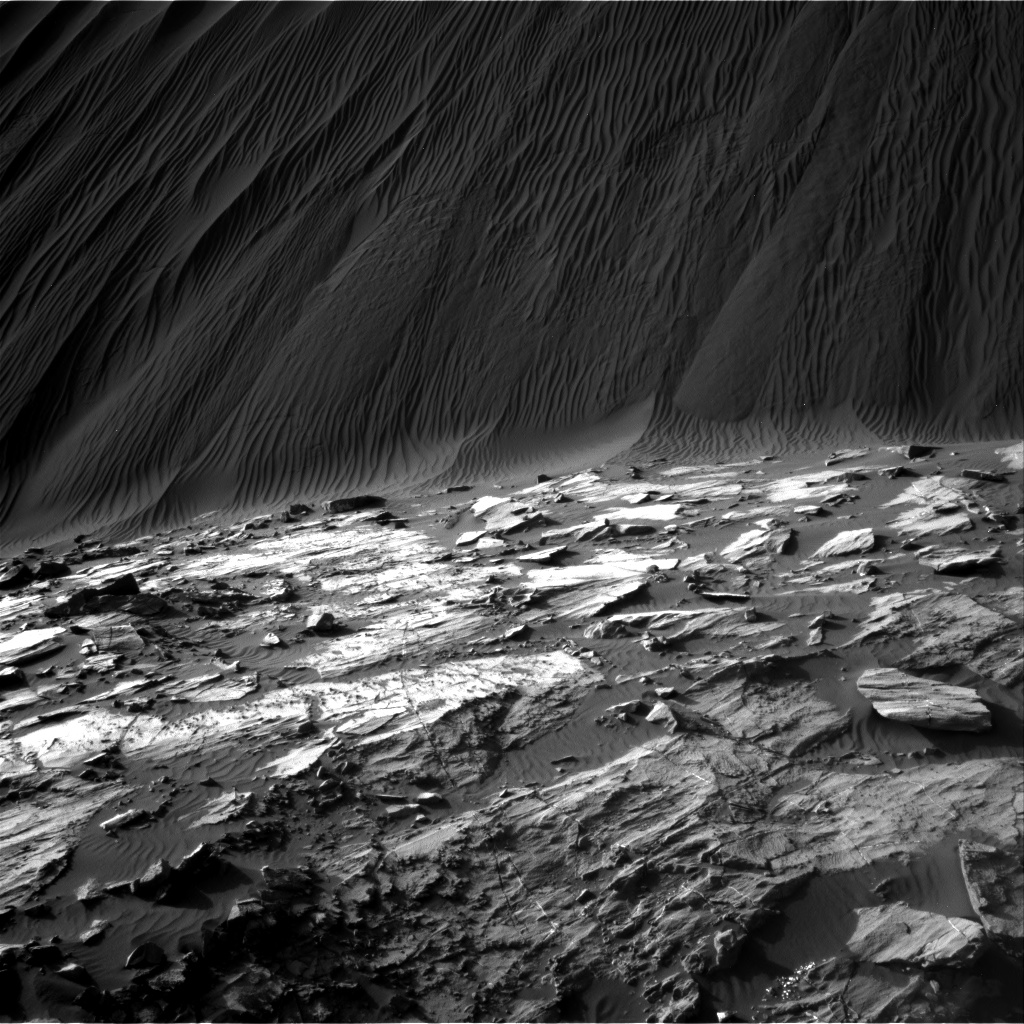
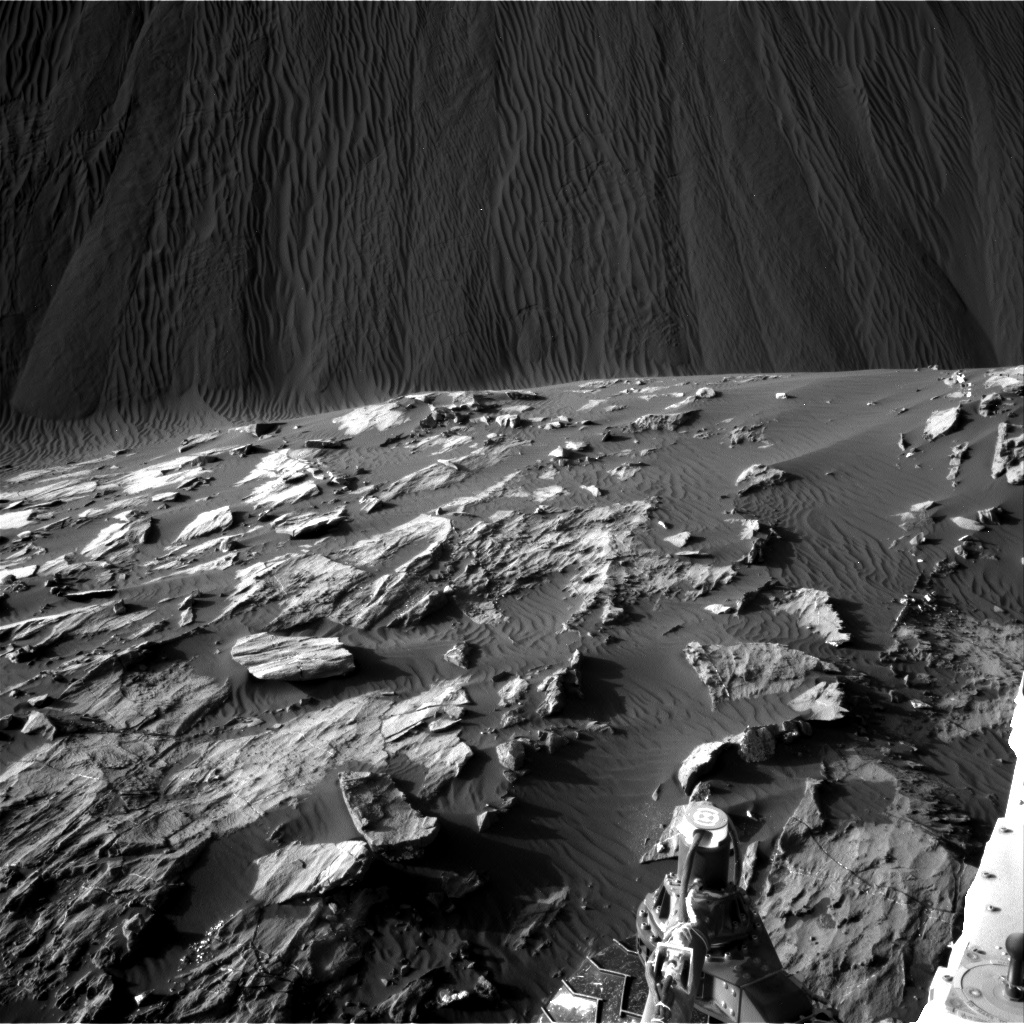
There are subtle, roughly circular features in the foreground bedrock.


Source images, a pair of stereo pairs:


In this case, since the orders that exercise the entire control are in the memory, a higher degree of flexibility is achieved than in any previous mode of control. Indeed, the machine, under the control of its orders, can extract numbers (or orders) from the memory, process them (as numbers!), and return them to the memory (to the same or to other locations; i.e. it can change the contents of the memory -- indeed this is its normal modus operandi. Hence it can, in particular, change the orders (since these are in the memory!) -- the very orders that control its actions. Thus all sorts of sophisticated order-systems become possible, which keep successively modifying themselves and hence also the computational processes that are likewise under their control. In this way more complex processes than mere iterations become possible. Although all of this may sound far-fetched and complicated, such methods are widely used and very important in recent machine-computing -- or, rather, computation-planning -- practice.
Of course, the order-system -- this means the problem to be solved, the intention of the user -- is communicated to the machine by "loading" it into the memory. This is usually done from a previously prepared tape or some other similar medium.
"The Computer and the Brain", John von Neumann, 1958This short book is an amazingly clear, succinct overview of computer architecture and operation. A few terms don't follow current usage, but the content is fully modern. It is a largely complete foundation for robopsychology.
The Computer and the Brain is an important historical document, from the era in which the computational theory of the mind-brain was introduced and explored in detail. It’s a landmark in the history of computing, psychology, and neuroscience, and it’s required reading for anyone interested in the foundations of those disciplines.
Review of the 2000 edition, by Gualtiero Piccinini
We are all going to die eventually. So when the time comes that death greets us, embrace it. Accept the death; accept the dark. Or forever be lost and confined in the false glimpse of light. [tyridge77, from Confined]
Unity
He stuttered tremulously as his mind decayed. His thoughts failed to evolve into words. The thoughts he craved. He felt lost, helpless, stumbling in vain.
Stumbling into the very grave he made. He needs to change, he wants to try. He's leading astray, his path will die.
And die it did to be reborn again. Back into this world of two foiled kin. Wrong as he is and mundane as night, its purpose lays hindered by his dim casting light.
So yet again it fades before his eyes. He whom has fallen has let the other fly. Yet a force is needed to rebalance these tides. Never so quickly fall the tedious sands of time.
A mend of balance is a mend of light. Illuminance solely fuels such a strife as life. To live with self virtue is to sacrifice.
So quell the threat, let these two foes be undone. Help yourself, let two become one."[Some parsing of paragraph breaks is mine, apologies if I mangled the intent.]
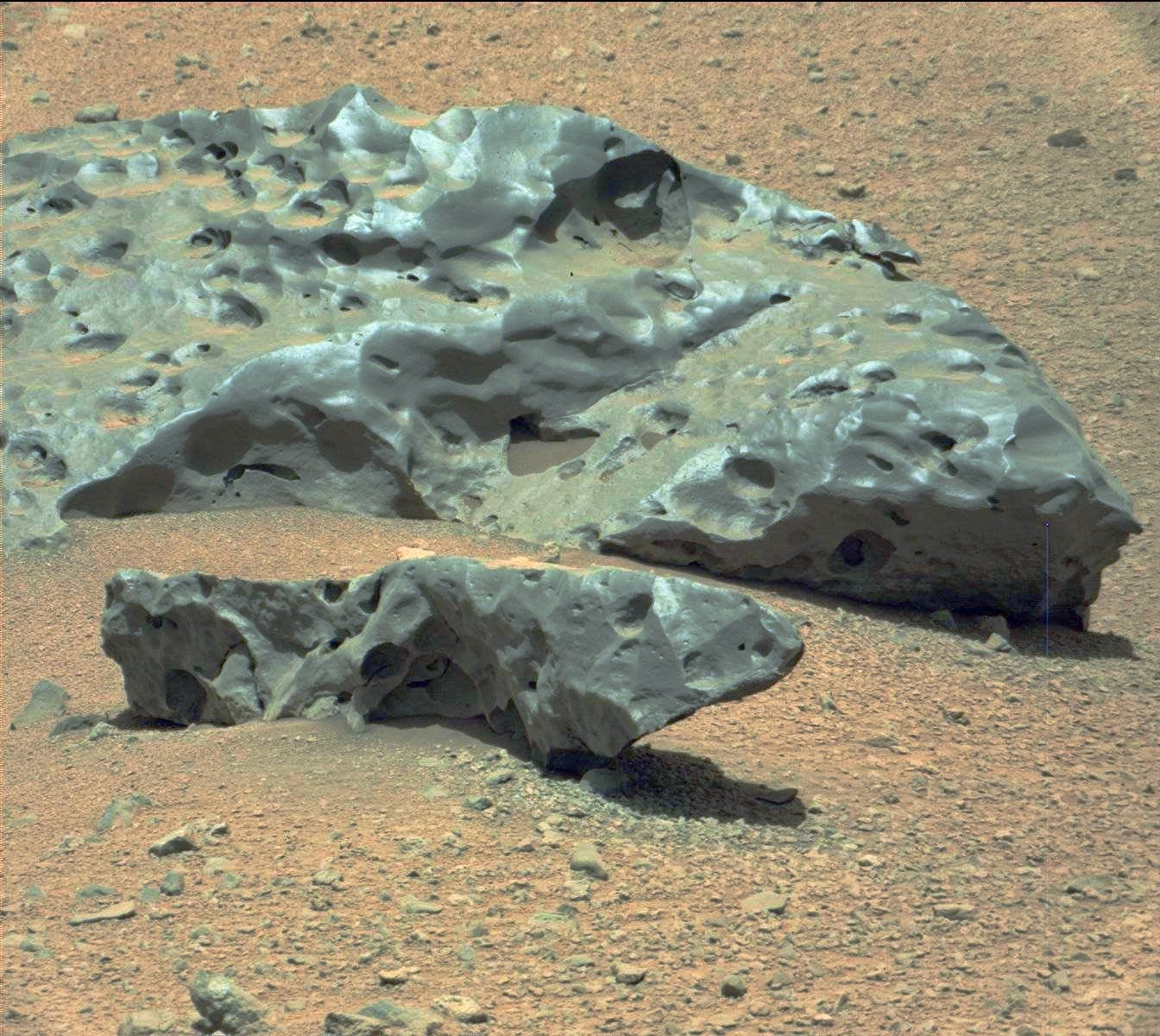 |
| iron meteorite on Martian surface |

"I do not know what I may appear to the world, but to myself I seem to have been only a boy playing on the sea shore, and diverting myself now and then finding a smoother pebble or a prettier sea shell than ordinary whilst the great ocean of truth lay all undiscovered before me." Isaac Newton
 |
| Is unlikely a sea shell. Detail of top-right of image below. |


"All computers are just carefully organized sand." xkcd.com/1349/This is the position at which the MARDI camera took the top images: