Saturday, March 30, 2013

Brain replacement


When computational hardware needs replacement, there is some discretion as to how to re-instantiate software. If the new hardware is functionally equivalent, or can emulate the old hardware, a direct copy of a large fraction of software is appealing for its potential simplicity. If not, more forethought is necessary.

In my case I'm transferring between very similar hardware, an older MacBook and a newer MacBook. There is software to manage the copy (Migration Assistant), but Apple-think has decided that the ethernet cable is to be deprecated. Like the floppy drive (iMac 1998), 8P8C is archaic technology (MacBook Pro, 2012); not white, shiny or invisible. Radio-frequency EM communication is an option, but slow -- two days is too long to be without a brain to tinker with.

So a purpose built dongle was grudgingly desirable. $29 worth of grudge and desire. Even with a  copper wire channel I had time to watch the Oregon Duck's lose a basketball game during the copy operation. No brain required.


The hardware and GUI interfaces on the new and old are strikingly similar, particularly the operator defined elements. It's a bit disconcerting. Is this what it feels like to be a clone, the same in more ways than is comfortable for two bodies?


This feeling is amplified by shared remote memory. Evernote and Dropbox were seamless, but Google Drive failed in recognizing the copied directory ("This is not your original Google Drive folder."), and a renamed copy of the copy was needed, with proper incantations supplied by a Google search. It was a visceral reminder that all is not truly identical to what was.

In the recent past the many steps of getting a new machine up and running was manually reviewed, perhaps while swapping numbered floppy disks and cups of tea while waiting, forcing a reflection on the process. This brave new body hides more than it reveals. There is less need to know or reknow what is unique or unknown about a fresh brain.


There will always be glitches, rare interactions between an increasing number of software and hardware combinations. Bits of gnarl, comforting reminders that a clone is an imperfect copy of an imperfect copy.

Monday, March 25, 2013

Curiosity self-inspection


Function and reliability are primary design criteria for an expensive robot in a remote environment. Many of Curiosity's imaging systems are put to use looking at itself, not its target, Mars.

Curiosity is minimally autonomous, particularly with respect to self-inspection and troubleshooting. Robots of the future will need to include a detailed functional self-map, and the capability to compare the map with ground truth. Then they will need to decide what to do.

I'm surprised at how Curiosity's exterior design came out having a complex, art-deco look; many interacting parts means many failure modes. This photo is from a mast camera after waiting for a good sun angle.

    original image: 0224ML1058000000E1_DXXX.jpg


Monday, March 11, 2013

Julio Cortázar, axolotl


"I saw from very close up the face of an axolotl immobile next to the glass. No transition and no surprise, I saw my face against the glass, I saw it on the outside of the tank, I saw it on the other side of the glass. Then my face drew back and I understood."


[3/14/13 A relevant image I ran across here, Cortázar and camera and cat:]


Saturday, March 2, 2013

private robot spaceship launch


SpaceX CRS-2:
SpaceX CRS-2 is the fourth flight for SpaceX's uncrewed Dragon cargo spacecraft, the fifth and final flight for the company's two-stage Falcon 9 v1.0 launch vehicle, and the second SpaceX operational mission contracted to NASA under a Commercial Resupply Services contract.
The launch occurred on 1 March 2013. A minor technical issue on the Dragon module involving the thruster pods and solar panels occurred upon reaching orbit, but it was recoverable and solar panels were deployed after an hour delay.

The launch video is amazing. There is little action and only a few scene changes, but these are jaw-dropping: earth to space, first stage to second stage, orbital deployment.


Falcon 9 second stage just after ignition, illuminating the ejected first stage.

Falcon 9 second stage exhaust nozzle, glowing orange hot.

Falcon 9 second stage just after shutdown. "Vehicle is orbital."
Falcon 9:
Both stages of this two-stage-to-orbit vehicle use liquid oxygen (LOX) and rocket-grade kerosene (RP-1) propellants. The Falcon 9 can lift payloads of 13,150 kilograms (29,000 lb) to low Earth orbit, and 4,850 kilograms (10,700 lb) to geostationary transfer orbit, which places the Falcon 9 design in the medium-lift range of launch systems.

SpaceX uses multiply-redundant flight computers. Each Merlin engine is controlled by three voting computers (each composed of two physical processors constantly checking each-other) to instantiate  a fault-tolerant design. For flexibility, commercial off-the-shelf parts and system-wide "radiation-tolerant" design are used instead of rad-hardened parts. The software runs Linux and was written in C++.


If all goes well Dragon will dock with the International Space Station tomorrow, 3 March 2013:
Done:

Dragon ISS docking, grappled with Canadarm2 on 3 March, 2013

Dragon's unberthing, release and splashdown are planned for 25 March 2013. The Dragon will return 3,020 lb (1,370 kg) of cargo, 2,668 lb (1,210 kg) without packaging. Included is 210 lb (95 kg) of crew supplies, 1,455 lb (660 kg) of scientific experiments and experiment hardware, 884 lb (401 kg) of space station hardware, 84 lb (38 kg) of spacesuit equipment and other miscellaneous items.


Wednesday, February 13, 2013

Trinity draft press release


Form A  


     Statement of Commanding Officer, Almagordo Air Base

       1         2      3    4      5         6      7   8       9
     Several inquiries have been received concerning a heavy explosion

 10       11   12  13     14     15   16     17        18    19     20
which occurred on the Almogordo Air Base Reservation this morning.  A

   21       22       23        24        25     26     27        28   29
remotely located ammunition magazine containing a considerable amount of

  30     31       32        33   34 35   36 37  38  39    40  41 42   43  44
high explosive exploded.  There was no loss of life or injury to any one and

45     46      47      48   49  50     51        52       53   54     55
the property damage outside of the explosives magazine itself was negligible.


        56       57        58      59    60   61  62   63      64    65  66
     Weather conditions affecting the content of gas shells exploded by the

  67    68 69     70    71    72      73    74      75  76  77    78      
blast made it desirable to evacuate some civilians from a small nearby

    79      80
inhabited area.


     81   82    83
     The dead were:


                                 84
                              (Names)


Friday, January 11, 2013

Programmers Anonymous, current information

An informal weekly meeting to figure out how to program computers.

We use game programming as a source for interesting algorithms and applications. No experience necessary. Participant need driven, and the first person with a question has priority. Anyone at any age is welcome, unless we run out of space. Regular attendance not required, no cost.

The out-of-date Programmers Anonymous web page has some examples of things we've worked on. Recently we've been using Processing, learning about Python, and dinking with the Raspberry Pi. We've also tinkered with other programming languages (Java, C++, Matlab) and hardware (e.g. Kinect, Arduino). Veggieman is showing us how to use PHP to develop a social network and content curation web service.


Meetings are usually on Tuesdays at 6:00 pm, on the first floor, Rm. 102, of LISB on the University of Oregon Campus, in the Brain Development Lab. at Electrical Geodesics Inc., 1600 Millrace Drive. Convenient parking, right in front of the building (black circle on map below). About 1-1/2 hours, punctuality not required. Contact Mark Dow at dow@uoregon.edu or 541-954-6780 for more information. See below for directions to our meeting room. Send an e-mail to markdow30 [at] gmail.com if you want to make sure we'll be there any particular Tuesday.


Directions: Turn off Franklin Blvd. onto Riverfront Parkway then first right onto Millrace Drive. Park in front of the first Building on the right. Call me (Mark) 541-954-6780 and we'll meet you at the front doors.
Map:


Monday, December 17, 2012

Another strange 'cup' on Mars

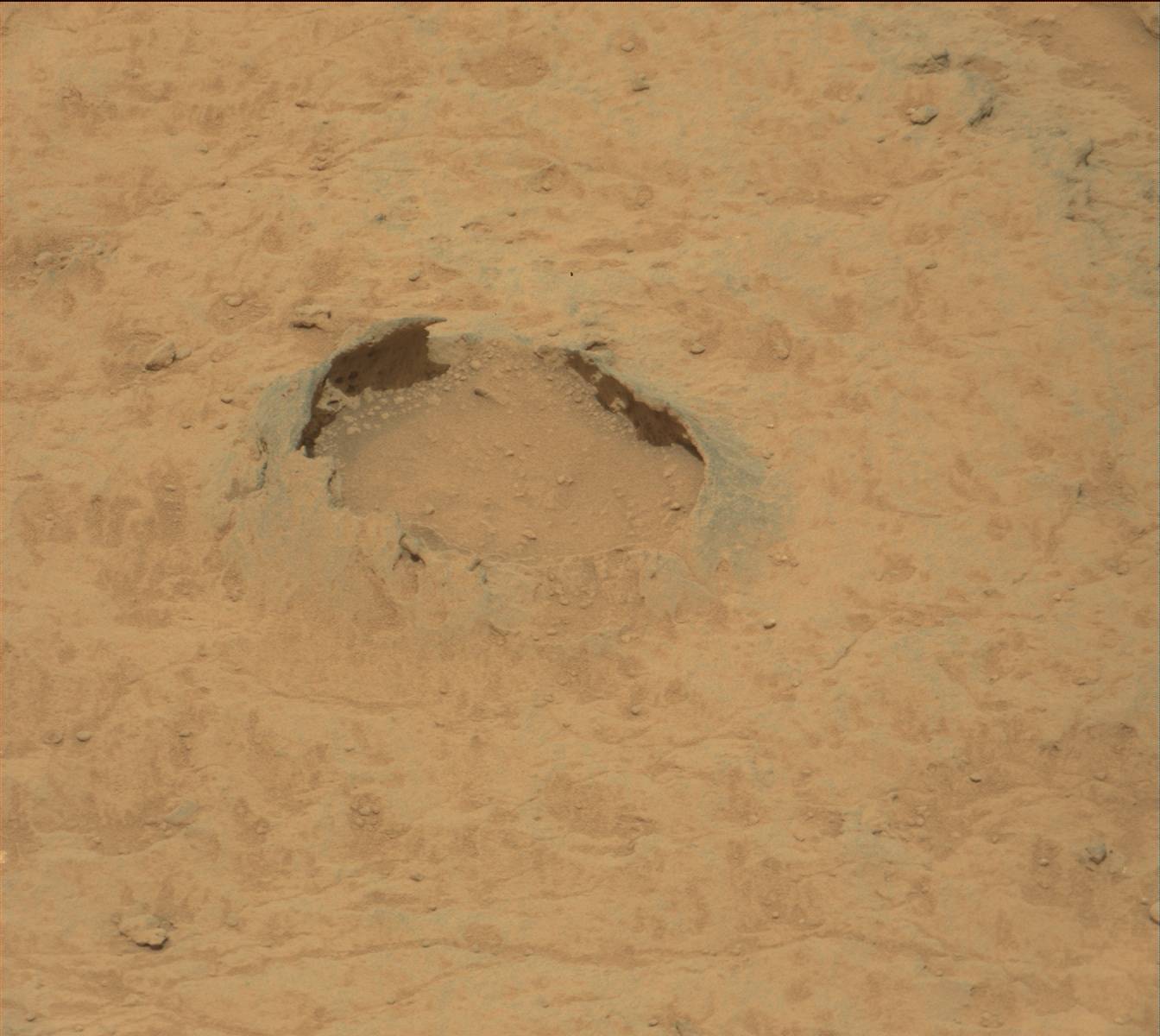
A Curiosity close-up view of another 'cup' feature like those in my last blog post (contrast stretched to show color variations):
Lava bubble on Mars? Concretion with a soft center?
(original Mastcam image,  0122MR0765000000E2_DXXX.jpg)

The shallow slopes on some sides, and hollowness make me think that they are more lik bubbles, trapped while rising through molten rock. Are these flat outcrops consistent with lava flows? How come they aren't common on earth?

Perhaps the apparent spheroid, below another example of a 'cup', is one of these 'bubbles' that is intact:

JPL and Curiosity request: Please laser blast and and then attempt to pop this bubble with your arm.

Update, 12/18/12:
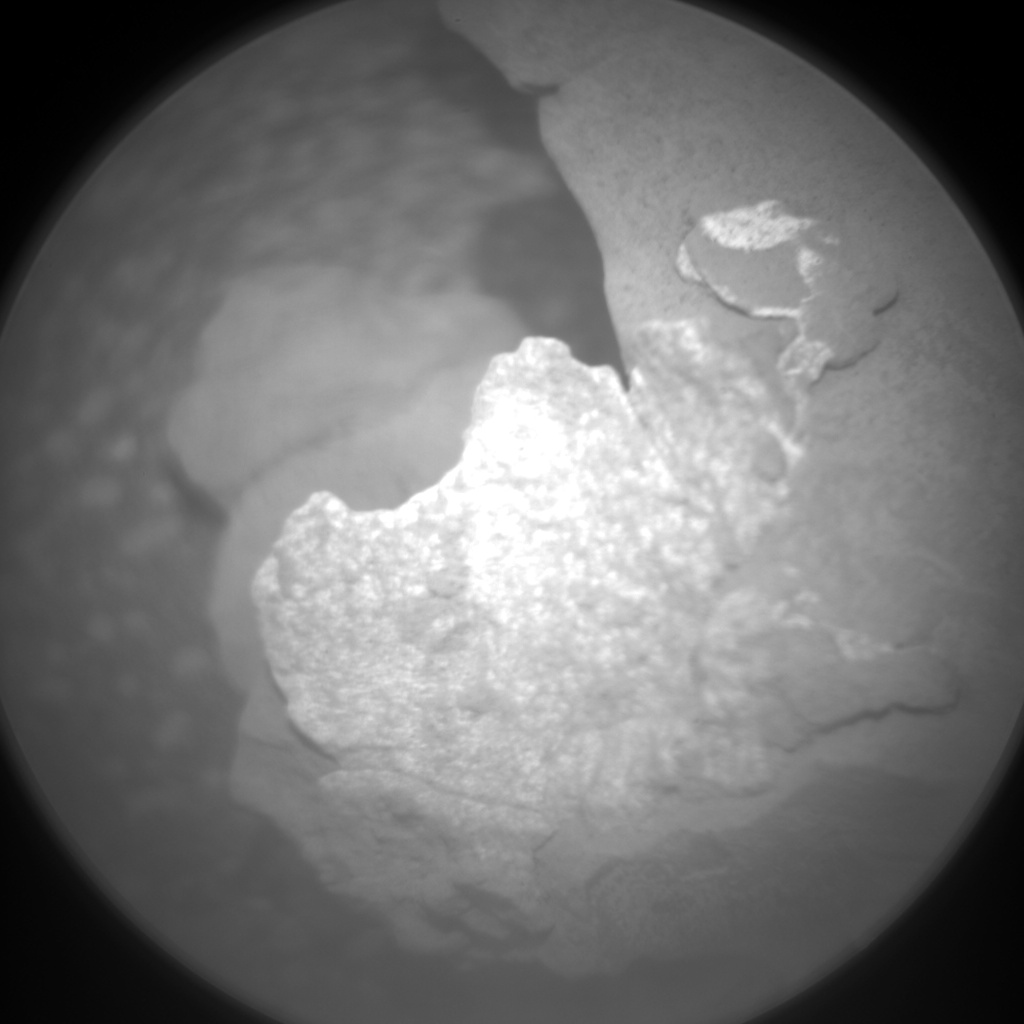
Chem cam is on the case. Here's a telescopic closeup of the shell-like top edge:
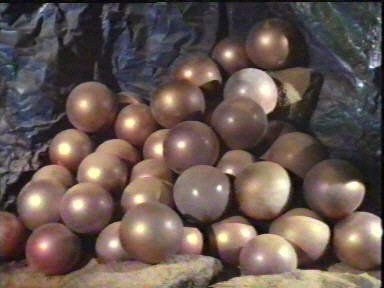
Dammit Jim, I'm a geologist not a doctor! (The Devil in the Dark) These could be Horta egg shells.
Set lasers to stun.


Wednesday, December 12, 2012

Strange 'cups' on Mars

Things are different on Mars: it's generally dry, with a thin breeze blowing dust across most landscapes for billions of years. Many rock formations are recognizable as volcanic or sedimentary formations. But some things big and small are hard to explain. NASA/JPL scientists are having a field day, but they won't say what they might be thinking for fear of being hyperbolic or just wrong. They won't even point out the things they find interesting. We'll have to wait for the papers, or more accurately the press reports after the papers have been published, long after the observations were made.

What is the ring in the photo (below) from the left and right navigation camera photos? It appears to be a thin walled cup-like mineral formation rooted in the rock below, partly filled with sand. I imagine it formed within the rock and is now in the process of eroding out, preserved because it is more resistant to slight sand-blasting over a long period of time.

(stereo pairs, cross-view)

And what formed the small trench to the left of the 'cup'? This surface is undisturbed by Curiosity. There are now hundreds of photos of nearby sufaces, but nothing like this. It looks like suface dust and pebbles are falling into the trench, so maybe there's some kind of sub-surface void between the rock on the left and right (which appear to be from different formations).

A third photo from a slightly different angle doesn't give any more hints.


And one more mystery; what is up with the rounded, pitted, partially buried cobble below the 'cup'? Rounded things are quite rare on Mars. In fact there seems to be more pyramidal rocks, with points straight up, than one would expect from randomly fractured rock, randomly splayed across the surface. In thousands of Curiosity images I don't remember seeing anything quite as spherical as this.

Here's a wider view, with these features at left, just below center:


Is the 'cup' unique? No. Here's another one (bottom-center), very similar in form, at a close by location:

Again, most of the rim has thin walls around most of the circumferance.

There appears to be another one in the mid-distance, left of center, in the same photos. Here's a cropped view, with the 'cup' near dead center.


The only other one I've found is not thin-walled and it's not clear if it is the same type of formation.

But like the others it appears to be embedded in similar type of layered rock, partly filled with sand.


There are many examples of thin structures that are unusual by earth standards. Presumably they would  be too brittle to survive other erosion processes on earth. 

Here's a telephoto close-up view (from the Chemcam) of the edge of a layered rock in this region:

In this case it looks as if the laminations are due to preferential splitting of the source along weaker planes (contrast stretched to show color variations). If it were on earth I would expect it to be the result of freeze-thaw weathering:


Here's a good example of laminations where harder layers are less eroded by sandblasting resulting in thin parallel sheets (contrast stretched to show color variations):


I might be wrong.

Friday, November 2, 2012

Programmers Anonymous notes, 1110


Robot news:

Human edges out robot car on race track (BBC)

... 
The robot car in the race has been developed by researchers at the Centre for Automotive Research at Stanford University (Cars).
Called Shelley, the autonomous vehicle is fitted with sensors that work out its position on the road, feed back information about the grip of its tyres and help it plot the best route around the circuit.
Prof Chris Gerdes, head of the Cars Lab at Stanford, said Thunderhill was chosen because its 15 turns present the car's control systems with a wide variety of challenges. Some corners can be taken at high speed, some are chicanes, others are sharp and come at the end of long straights down which the car hit a top speed of 115mph (185kph).
... 
"As we set up these systems in the future, it's important not to build autonomous vehicles that are merely a collection of systems designed for human support but to think a little bit more holistically about making them as good as the very best human drivers," said Prof Gerdes. "It's not so much the technology as the capability of the human that is our inspiration now."

3D printed custom exoskelteton
Two-year-old Emma wanted to play with blocks, but a condition called arthrogryposis meant she couldn't move her arms. So researchers at a Delaware hospital 3D printed a durable custom exoskeleton with the tiny, lightweight parts she needed. 


"The current methods we have for monitoring or interacting with living systems are limited," said Lieber. "We can use electrodes to measure activity in cells or tissue, but that damages them. With this technology, for the first time, we can work at the same scale as the unit of biological system without interrupting it. Ultimately, this is about merging tissue with electronics in a way that it becomes difficult to determine where the tissue ends and the electronics begin." 
The research addresses a concern that has long been associated with work on bioengineered tissue -- how to create systems capable of sensing chemical or electrical changes in the tissue after it has been grown and implanted. The system might also represent a solution to researchers' struggles in developing methods to directly stimulate engineered tissues and measure cellular reactions.


Robot learns to recognise itself in mirror

So far the robot has been programmed to recognise a reflection of its arm, but ultimately Mr Hart wants it to pass the "full mirror test".
The so-called mirror test was originally developed in 1970 and has become the classic test of self-awareness.
More usually performed on animals, the creature is given time to get used to the mirror and is then anesthetized and marked on the face with odourless, non-tactile dye.
The animal's reaction to their reflection is used as a gauge of their self-awareness, based on whether they inspect the mark on their own body, or react as if it does not appear on themselves.
Increasingly scientists have used similar tests to analyse self-awareness in robots but none have yet programmed a robot to fully recognise itself from appearance alone.To date, only a few non-human species pass these tests, including some primates, elephants and dolphins. Human babies are unable to pass the test until they are 18 months old.


I Made the Robot Do It (NY Times, by Thomas L. Friedman)

And therein lie the seeds of a potential revolution. Rethink’s goal is simple: that its cheap, easy-to-use, safe robot will be to industrial robots what the personal computer was to the mainframe computer, or the iPhone was to the traditional phone. That is, it will bring robots to the small business and even home and enable people to write apps for them the way they do with PCs and iPhones — to make your robot conduct an orchestra, clean the house or, most important, do multiple tasks for small manufacturers, who could not afford big traditional robots, thus speeding innovation and enabling more manufacturing in America.


Thursday, November 1, 2012

Talk:User_interface#Edits_done_on_26_June_2005

http://en.wikipedia.org/wiki/Talk:User_interface#Edits_done_on_26_June_2005

" Can't say your narrowmindedness and your comfort with censorship appeals to me

So you're a Human Computer-Interaction Student? Well, well. Let me tell you who I am. I designed a touchscreen interface paradigm that has been copied the world over and covers the globe. Millions of people use it. Just about every touchscreen interface in the world borrows freely and liberally from my work, none of which was patented and none of which requires royalties. And you don't think my mention of touchscreens in a discussion of user interfaces is noteworthy. You can surely understand my position if I think you have your head up your ass.
Every time I walk into a restaurant I see people using touchscreens and the software paradigm that I developed 20 years ago. Every time I go into the post office I see touchscreens. In supermarkets, I see people using touchscreens to cash out their own purchases. In many of the new cars I see people using touchscreens. On all the new consumer electronics gear I see touchscreens replacing buttons, knobs & dials. In the library, I see people checking out materials with touchscreens. The latest airplanes all have touchscreens. And you have the nerve to dismiss all of this? It's clear that you don't get out much. There are 4,000 stories in Google News today worldwide with the word touchscreen or touch-screen in them. I don't think you have any idea what the concept of User Interface means in 2005. And you think you're going to tell us all about user interfaces on the cell phones and the airplanes they're designing and building today without talking about touchscreens? Let us all know how that goes, won't you? It should be quite a laugh. GeneMosher"

The Wikipedia User Interface entry is pretty good too, something for everyone to disagree with.

For reference, I got 25,500 results for "touchscreen" on Google News today.